

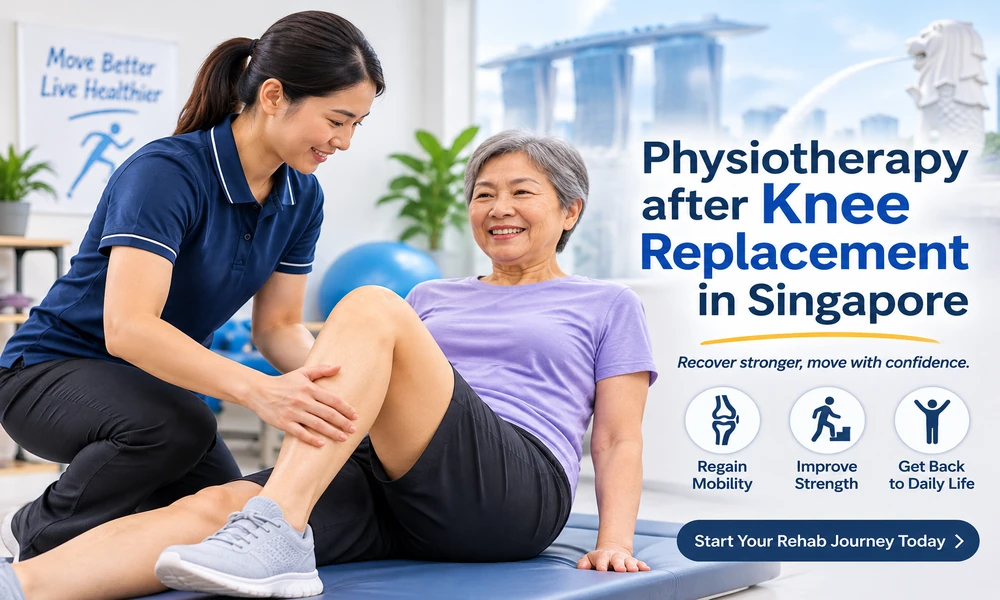
Rehabilitation after knee replacement focuses on restoring knee movement, rebuilding lower-limb strength, and progressively returning to walking and everyday activities. Physiotherapy after knee replacement in Singapore can provide a structured progression based on surgical guidance, physical function, and the individual’s recovery needs.
Knee replacement rehabilitation commonly addresses range of motion, quadriceps strength, swelling, walking ability, and functional tasks such as standing from a chair and climbing stairs. Post-surgery physiotherapy in Singapore should progress according to the person’s clinical presentation and medical instructions rather than assuming that everyone will recover at the same rate.
What Is Knee Replacement Rehabilitation?
Knee replacement rehabilitation is the structured process of restoring movement and physical function following knee replacement surgery. It begins with basic mobility and progresses towards strength, walking capacity and greater independence in everyday activities.
A knee replacement procedure replaces damaged joint surfaces with artificial components. Although the procedure addresses the joint itself, muscles and surrounding tissues still need time to recover from surgery.
Reduced activity before and after surgery may also contribute to muscle weakness. Rehabilitation therefore needs to consider the entire lower limb rather than focusing only on the replaced joint.
The specific programme should follow instructions from the surgical team, particularly when individual medical considerations or procedure-specific precautions apply.
What Happens During Early Recovery?
Early recovery generally focuses on safe mobility, appropriate knee movement and basic muscle activation. The exact timing of activities depends on medical guidance and the individual’s condition.
Walking may begin with an appropriate mobility aid, depending on instructions from the healthcare team. Simple exercises can also be introduced to encourage movement and activate muscles around the knee.
Early rehabilitation may address several priorities:
- Safe transfers between sitting and standing
- Appropriate walking with a mobility aid
- Knee bending and straightening within permitted limits
- Quadriceps activation
- Gradual increases in everyday mobility
These early activities establish a foundation for the more demanding strengthening and functional exercises introduced later.
Managing Swelling During Knee Replacement Recovery
Swelling is common following knee replacement because surgery creates a normal tissue-healing response. The amount of swelling and how long it remains noticeable vary between individuals.
Swelling can contribute to stiffness and may temporarily make it more difficult to activate the muscles around the knee. It can also fluctuate according to activity levels during recovery.
Activity progression should therefore consider how the knee responds during and after exercise. A substantial increase in swelling following a change in activity may indicate that the current workload needs to be reviewed.
Patients should follow medical advice regarding post-operative swelling management. Unexpected, severe or rapidly changing symptoms should be discussed with the surgical team rather than assumed to be part of routine recovery.
Why Restoring Knee Range of Motion Matters
Knee range of motion is important for walking, sitting, standing, climbing stairs and other everyday activities. Surgery, swelling and pain can temporarily limit both knee bending and straightening.
Rehabilitation may use controlled exercises to progressively restore movement. The appropriate intensity should account for symptoms, tissue healing and surgical guidance.
Knee extension, or the ability to straighten the knee, contributes to efficient standing and walking. Knee flexion, or bending, is needed for sitting, stairs and many functional movements.
The aim is to restore useful range of motion rather than aggressively forcing the knee regardless of its response.
Why Quadriceps Strength Is a Major Rehabilitation Goal
Quadriceps strength is important because these muscles help straighten and control the knee during walking, standing, and stair climbing. Weakness can be particularly noticeable after knee replacement surgery.
Pain, swelling, and reduced activity can temporarily affect how effectively the quadriceps work. Early rehabilitation may therefore include exercises designed to restore basic muscle activation.
As recovery progresses, strengthening can become more demanding. Depending on the person’s stage of rehabilitation, exercises may include controlled sitting and standing, step exercises and resistance-based movements.
Strength should be progressed according to individual capacity. Comfortable walking alone does not necessarily mean that lower-limb strength has fully returned.
Rebuilding Strength Beyond the Knee
Lower-limb rehabilitation should address more than the quadriceps because walking and everyday activities require coordinated function across several muscle groups. The hips, hamstrings, and calf muscles also contribute to mobility.
Reduced activity surrounding surgery can affect overall lower-limb conditioning. Exercises may therefore progressively target multiple areas as the person becomes capable of greater physical demand.
A broader strengthening programme can support tasks such as:
- Rising from a chair.
- Walking for longer periods.
- Climbing and descending stairs.
- Maintaining balance while standing.
- Managing household and community activities.
The exercises selected should reflect the individual’s current ability and functional goals.
How Walking Progresses After Knee Replacement
Walking progression aims to restore safe and increasingly independent mobility. The starting point depends on the individual’s surgical guidance, strength, balance, and general condition.
Some people initially require a walking frame, crutches, or another mobility aid. These devices can provide support while the person develops greater control and confidence.
Progression away from a walking aid should be based on appropriate clinical guidance rather than stopping its use simply because a certain number of days or weeks has passed. Walking quality, balance, and safety are important considerations.
Distance and duration can also increase gradually as endurance improves. Walking too far too quickly may unnecessarily aggravate symptoms during early recovery.
Why Walking Quality Matters
Walking quality matters because knee replacement can temporarily change how a person distributes weight and moves the affected leg. Pain, stiffness, or weakness may lead to shorter steps or greater reliance on the other side.
Rehabilitation can help restore more comfortable and efficient movement as knee motion and strength improve. This may include practising weight transfer, step patterns, and appropriate use of walking aids.
The goal is not to make every person’s walking pattern identical. Individual differences are normal.
Instead, rehabilitation aims to reduce avoidable limitations and support a safe walking pattern that allows the person to manage everyday environments.
Returning to Stair Climbing
Stair climbing requires knee mobility, quadriceps strength, balance and confidence. It can therefore remain difficult even after level walking has improved.
Early in recovery, some people use a modified stair pattern according to guidance from their healthcare team. As strength develops, rehabilitation can progressively prepare the operated leg for greater involvement.
Step exercises may be introduced and gradually made more demanding. The height of the step, amount of support and number of repetitions can all be adjusted.
Descending stairs can sometimes feel more challenging because it requires controlled lowering of body weight. Progressive quadriceps strengthening can be particularly relevant to this task.
Returning to Everyday Activities
Functional recovery means regaining the ability to perform meaningful daily tasks safely and with increasing independence. These activities vary between individuals and should help guide rehabilitation priorities.
Early goals may include getting in and out of bed, using the bathroom, dressing, and moving around the home. Later goals can involve shopping, household tasks, and longer periods outside the home.
Exercise progression should support these practical activities rather than exist separately from them. For example, strengthening the legs can contribute directly to easier chair transfers and stair climbing.
Recovery can therefore be evaluated through improvements in both exercise performance and everyday function.
How Exercise Progression Changes Over Time
Exercise progression involves increasing physical demand as the knee heals and the individual becomes stronger. The programme should evolve rather than repeating the same basic exercises throughout recovery.
Early exercises may prioritise movement and muscle activation. Later rehabilitation can introduce greater resistance and more complex functional tasks.
Exercise can be progressed by changing:
- Resistance
- Repetitions
- Movement range
- Duration
- Functional complexity
Increasing exercise demand should be balanced against the knee’s response. Progress does not require making every exercise harder at the same time.
Returning to Work After Knee Replacement
Returning to work depends on the physical requirements of the person’s occupation as well as medical guidance and functional recovery. Desk-based work and physically demanding roles can require different rehabilitation milestones.
A desk-based worker may need sufficient sitting tolerance and the ability to travel safely between home and work. Regular position changes may be useful if prolonged sitting contributes to stiffness.
People whose jobs involve prolonged standing, stairs, lifting or extensive walking may require greater strength and endurance before unrestricted duties are appropriate.
Where possible, a graded return can allow working demands to increase as physical capacity improves.
Returning to Exercise After Knee Replacement
Returning to exercise should be guided by the type of activity, individual recovery and recommendations from the surgical team. The appropriate activities may differ from those performed before surgery.
Lower-impact forms of exercise may be introduced as mobility and strength improve. Resistance training can also play an important role in rebuilding lower-limb capacity when performed appropriately.
More demanding recreational activities require careful consideration of the joint replacement, previous experience and medical recommendations.
Physiotherapy can help prepare the body for suitable activities by developing the strength, mobility and balance required to perform them.
Factors That Can Affect Recovery
Recovery after knee replacement varies because surgical and individual factors influence how quickly function returns. Comparing progress directly with another person’s recovery may therefore be misleading.
Relevant factors can include pre-operative strength, previous mobility, general health, the surgical procedure and the physical activities the person wants to resume.
Consistency with an appropriate rehabilitation programme can support progress, but temporary fluctuations in swelling, stiffness or exercise tolerance may occur.
Rehabilitation should be adjusted according to the individual’s clinical response while remaining consistent with guidance from the surgical team.
When Post-Operative Symptoms Need Medical Review
Unexpected or significant changes after knee replacement should be medically reviewed according to the instructions provided by the surgical team. Physiotherapy is intended to support rehabilitation and does not replace medical management of possible post-operative complications.
Concerns about the wound, unexpected changes in swelling or other symptoms that differ substantially from the anticipated recovery pattern should be reported appropriately.
A sudden loss of function or other significant new symptoms should also be assessed.
Patients should follow the specific post-operative warning signs and contact instructions provided by their surgeon or hospital because these are based on their individual procedure and medical circumstances.
Frequently Asked Questions (FAQs)
When does physiotherapy start after knee replacement?
Rehabilitation may begin relatively early after knee replacement, depending on the individual’s condition and surgical instructions. Early goals commonly include safe mobility, knee movement, and basic muscle activation.
How important is knee bending after surgery?
Knee bending is important for sitting, stairs, and many everyday movements. Rehabilitation progressively restores useful range of motion while accounting for swelling, symptoms, and medical guidance.
Why does my thigh feel weak after knee replacement?
Quadriceps weakness can occur because of surgery, swelling, pain and reduced activity. Progressive strengthening helps restore the muscle capacity needed for walking, standing, and stair climbing.
When can I stop using a walking aid?
The decision should consider balance, strength, walking ability, and guidance from the rehabilitation or surgical team. Stopping an aid based only on time may not reflect an individual’s functional readiness.
How long does knee replacement rehabilitation take?
Recovery varies between individuals and depends on surgical factors, pre-operative function, health and rehabilitation goals. Some daily activities may return relatively early, while rebuilding greater strength and endurance can require a longer rehabilitation period.
Rebuilding Confidence in Everyday Knee Function
Knee replacement rehabilitation progresses from basic postoperative mobility towards greater strength, walking capacity, and functional independence. Range of motion, quadriceps strength, balance, and gradual exercise progression all contribute to this process.
Recovery should be assessed through meaningful improvements such as walking more comfortably, managing stairs, and returning to daily activities. A structured programme can help match increasing physical demands with the person’s healing and functional capacity.
Continue Your Knee Replacement Recovery With The Bloom Rehab
Rehabilitation needs after knee replacement depend on the procedure, medical guidance and the person’s current mobility and strength. The Bloom Rehab can assess knee range of motion, walking, lower-limb strength and functional limitations to determine an appropriate post-operative rehabilitation progression.
If you need support rebuilding mobility and everyday function after knee replacement surgery, you can book your appointment with The Bloom Rehab.
